Gannon's Pleasant Hour saloon, Chicago 1890s
A piping haven on Halsted Street
It all started when I saw this article from the Milwaukee Journal from March 18, 1943:
- Ever Hear the Irish Bagpipe?
By Charles D. Stewart
"Forty-seven years ago there was an Irish piper playing in a basement saloon on Halsted st. in Chicago. I was a reporter on the Chicago Daily News and on hearing the sound went down and spent an evening listening to him. On the following evening there was no sound coming from the basement. On investigation the piper was found sitting disconsolate. He had taken a little too much usquebaugh the night before, and on the way home had lost one of the joints of his pipes. They come apart like the sections of a flute and can be put in the pocket. A little story of his predicament was put in the paper. On the following night the pipes were going again- someone had found the missing part and brought it back. It was this piper who gave me the lowdown on the pipes."
I had been researching old pipers for a couple years by the time I saw this article. The author was harkening back to the 1890s and I knew the names of several Chicago pipers from that era. Who could this be? Perhaps the answer would be in the "little story" published in the Chicago Daily News. At the time (2010s) I could find no digitized, indexed version of the Chicago Daily News, a large, generous urban paper. Trying to find such an article by scanning pages would be like looking for the haystack's needle. Years passed. In 2025 I was told that, yes, the Chicago Daily News was available online through GenealogyBank.com, and searchable. My searches returned some surprising information about pipers, a saloon, and the saloon's proprietor.
The only likely match for Mr. Stewart's story is an unsigned article "Tuohey Lost His Pipes" from Monday October 15, 1894, page 1. J. F. Touhey was playing pipes daily at Daniel Gagnon's saloon "in the basement at Harrison and Halsted streets." There was a dance at the place on Saturday night, Oct. 13, and Tuohey left about 3 o'clock Sunday morning with his pipes, probably very drunk. He passed out in the street and awoke without "bagpipes, coat, shoes and hat." The theft was reported to the police but the pipes had not been found by the time the article was published. There was no followup article in the paper.
The piper was James T. Touhey, who had performed with great success at the Chicago World's Fair in 1893. Probably for this reason the loss of his pipes received widespread newspaper coverage. No newspaper subsequently announced the recovery of his pipes but Touhey was performing again the next weekend, if a classified ad was to be believed. The ad, in the Chicago Daily News Oct. 20, announced Touhey "performs every evening at Dan Gannon's Pleasant Hour, 259 S. Halsted st."
This lead me to a remarkable series of classified ads promoting piping at the Pleasant Hour, Oct. 1894 - March 1896. The named pipers were professionals. With the possible exception of Tobin, all were show business veterans of good reputation.
James Touhey played at Gannon's Pleasant Hour, Harrison & Halsted streets Oct. 1894.
Eddie Joyce played in the basement at Gannon's Pleasant Hour, Dec. 9-14[?], 1895.
Adam Tobin played at Gannon's Feb. 16[?], 1895, and March 1896.
Pat Touhey played Gannon's for a "season" starting June 1895.
Joyce and the two Touheys were from out of town, but Adam Tobin lived in Chicago. He played at the Pleasant Hour many times, and features in an article about an evening's merriment in the saloon from the Chicago Chronicle, Nov. 10, 1895. "At one end of a big hall is a dancing platform" where sits Adam Tobin, sometimes joined by a fiddler. A crowd of 20 or so form around piper and fiddler. Occasionally someone from the crowd gets up to dance. When the musicians tire or take a break there is singing. "And with all the fun, the dancing and singing and music the place is as orderly as a prayer meeting."
During the years of piping activity the saloon's address was most often given as at the corner of Harrison and Halsted Streets. This intersection is in the Near West Side, in and near what is now known as the University Village neighborhood, west from downtown and on the west side of the Chicago River. Halsted runs north-south, Harrison east-west, and from their intersection began Blue Island Avenue, running southwest. A cable car line came from north Halsted and turned onto Blue Island. A horse car line ran west on Harrison. Near this intersection were shops, saloons, restaurants, a bakery. Light industry here and there; a bed spring factory, a mirror factory, a tin shop.
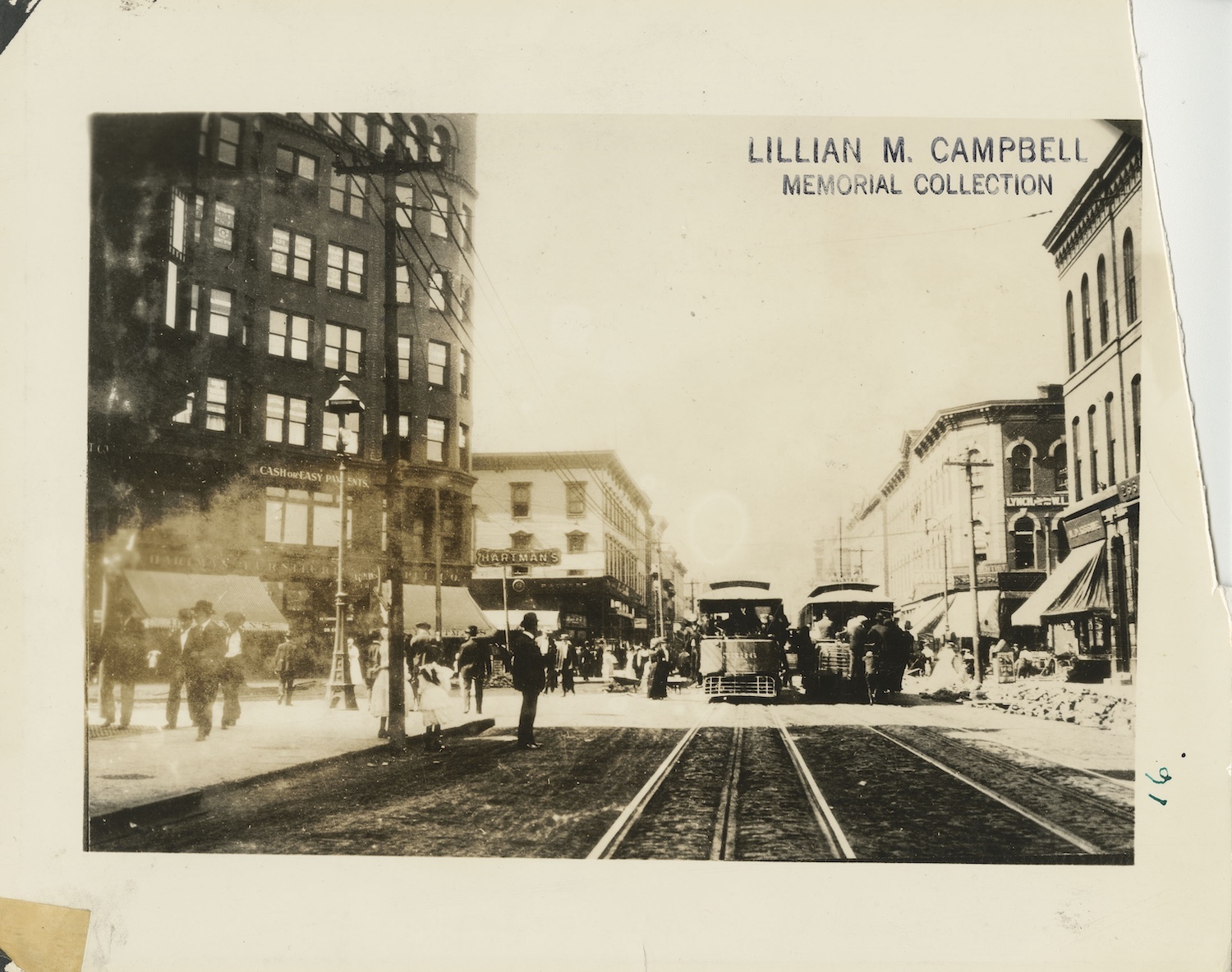
Halsted St. looking north with Harrison St. and Blue Island Ave. coming in from the left. Photo from 1906, ten years after the Pleasant Hour.
From the Lillian Campbell collection, Chicago Public Library.
The Pleasant Hour and its proprietor Dan Gannon were part of this neighborhood. Newspaper coverage suggests a busy, perhaps close-knit area. At least two articles suggest that a distinctive trait of the inhabitants was a love of wagering. "They are a trifle sporty out where Blue Island avenue branches off from Halsted street and the trolley cars get mixed up with the cable lines. Any kind of game will get their money in that locality...."
Dan Gannon was probably Daniel J. Gannon (1868-1941), born in County Roscommon, Ireland, immigrated to the United States about 1880. For much of the 1890s he was a saloon keeper, active in political matters. He and his saloon drew unwelcome attention from the police several times. In 1890 he was involved in a brawl in Halsted St. with another saloon-keeper, fined $30. In 1893 he was dragged off to the police station for keeping the Pleasant Hour open after midnight, the legal closing hour. He claimed to be singled out because of his opposition to Mayor Harrison, "forcing him to close his saloon while his neighbors who are friendly to the aspiration of the mayor are allowed to keep open." An 1894 report to a grand jury detailed illegal gambling activities in the Pleasant Hour. Gannon was arrested in May 1895 "on the charge of having music in his place." What qualities did Gannon have to be able to keep the establishment and the music going under such circumstances? Persistence? Persuasiveness? Guile?
The Pleasant Hour name was likely intended to evoke an earlier Pleasant Hour saloon, one in New York City. It was owned by Thomas F. Kerrigan, one of the foremost pipers of his day. It ran from about 1876 to 1898 and was remembered as "one of the best-known resorts in the city, and there were to be found the most famous reel, jig and clog dancers. Dancing and pipe-playing contests were held there frequently." The name had such positive associations that at least four other establishments of that name were active in twentieth century New York City (for this, see Richie Piggot's article, mentioned two paragraphs below).
Last mention of the Pleasant Hour in Chicago was in a classified ad on March 16, 1896. There are few and uncertain mentions of Dan Gannon after that. Today, the entire neighborhood itself is gone, displaced by the freeway intersection of Interstates 90 and 290, and the University of Illinois Chicago campus. Only newspaper citations and a couple photographs remain.
Note: Richie Piggott was much intrigued by the discovery of Chicago's Pleasant Hour. The use of the name by other saloons fascinated him. With research help from Michael Kelly, Piggott wrote an article 'Piping at the "Pleasant Hour" Saloons of America', published in An Píobaire Vol. 21 No. 4 Samhain/November 2025 pp. 20-27.
http://3.248.59.149/data/PIOBAIRE/PIOB2104.PDF
Transcribed articles
Tuohey Lost His Pipes.
"The dulcet tones of an Irish bagpipe could, previously to last Sunday, be heard emanating from the concert wein stube of Daniel Gagnon in the basement at Harrison and Halsted streets.
"Now the squeaky tones of a Scotch bagpipe mar the tranquility of that corner, and all because J. F. Tuohey got confused.
"Just how it all came about is a mystery to Mr. Tuohey, but, according to his recollections, the story runneth thus: The hero, Mr. Touhey, will be remembered as the blower of bagpipes in Lady Aberdeen's Irish village at the World's Fair. He has quite a reputation as a piper, having traveled with theatrical troupes for the last eleven years. He was with Katie Emmett shortly before the Fair and when it opened he left the stage to edify the public at closer range.
"After the fair closed he, like a good many others, was thrown out of employment. Thus it was that he came to be a piper in the concert saloon. There was a dance at the place Saturday night and the elite of Halsted street was present. About 3 o'clock Sunday morning the piper put his bagpipes under his arm and started up Halsted street.
"At this point slumber overtook him and he was dead to the world till 9 o'clock in the morning, when he awoke in the doorway of a building not far from Harrison street. During the slumber of the piper he was made the victim of designing people, for when he awoke he was minus his cherished bagpipes, coat, shoes and hat. It was with a woeful expression on his haggard countenance that he walked shoeless to the concert hall and told his troubles.
"Raiment was obtained to clothe him and he reported his loss to the Desplaines street police. Detective Rafferty was detailed on the case but has so far failed to locate the bagpipe. The instrument was manufactured for Mr. Tuohey at a cost of $300 and he says he would not lose it for triple that amount."
Chicago Daily News Oct. 15, 1894 Monday p. 1 column 4 (five o'clock edition)
GenealogyBank.com
-----
Announcements.
Miscellaneous.
"☞ J. T. Touhey, celebrated World's Fair Irish piper, performs every evening at Dan Gannon's Pleasant Hour, 259 S. Halsted st."
Chicago Daily News Oct. 20, 1894 p. 6 column 6
GenealogyBank.com
-----
Odd Tales of the Town.
HOME FOR IRISH LADS.
HOURS GO LIGHTLY.
'Over on Halsted street, just where Blue Island avenue branches out into business for itself, is a saloon, the only lineal descendant of the Irish village of glorious memory. The saloon itself, the bar and the kegs and the bottles are of secondary importance, from an artistic point of view, although of course they come in handy now and then. But the center of interest, what the crowd goes to see and hear and applaud is Adam Tobin, the Irish piper.
'Dan Gannon is owner, manager and master of ceremonies of this Hibernian retreat and he does the honors with a broad smile and a welcome to everyone. At one end of the big hall is a dancing platform, raised from the floor, and here sits Adam Tobin, with his pipes. Beside him Johnnie Rellins sits with a violin most of the time and the rattling tunes of the "ould dart" resound all night long until the hour for closing puts a stop to the fun. Every evening the crowd begins to drift in shortly after "supper time" and a little group is formed around the piper and the fiddler. Adam pumps the bellows, lets forth a few drones from the "complement" and runs his fingers idly over the instrument which brings joy to every Irish heart.
' "Give us 'The Connaught Man's Rambles', Adam," calls someone in the crowd, and after a few preliminary notes Tobin raises the tune.
'MANY FEET BEAT TIME.
'Fifty feet beat time and a score of old-tuners wag their heads to the music and before the "turn" in the tune comes, "Mattie" Dunne pushes his way through the crowd, mounts the platform, and begins the dancing. Mattie puts in his time at a stock yards packing-house during the day and his shoes are not patent leather dancing pumps, but his feet are as light as his heart when the pipes are sounded and many a stage dancer would make a poor showing near Mattie Dunne. And in the crowd which nightly gathers at Dan Gannon's are a dozen men like Mattie, men who can dance to the pipes and the violin with the steps of a fairy, although they may have been laying brick or driving a team all day.
'When Dunne gets tired of dancing, and, with a final flourish of his nimble feet, steps off the platform, the music stops with a long wail from the chanter. Adam Tobin cracks his fingers on his knee and then, setting them once more to the pipes, starts up "The Job of Journeywork." Johnnie Rellins comes in a good second with the violin and in five minutes a new dancer steps out of the crowd and up on the platform.
'DAN SHOUTS ENCOURAGEMENT.
' "Good boy, Jimmie," calls out Dan Gannon, "shake a foot there." And Jimmie shakes a foot till the tune changes to "Tatter Jack Welch" or "The Dark Haired Lass," and a partner climbs up to help the dancer.
'Sometimes the music dies out from the pipes and violin, the piper and his partner grow tired and go away for a drink, and then someone calls "Lave us have a song— Where's Mahoney?"
' "Good, good, Mahoney; come on, Johnnie," cry the loungers encouragingly, and Johnnie Mahoney pushes his way to the platform with many protests of his inability to sing. But when he gets up there at last and starts "My Buck Billy Goat" there is not a sound in the hall except an occasional "Good boy" from an enthusiastic listener until he finishes. That starts the singing. Someone else sings "The Blackbird" amid wild plaudits from the old-timers, and then "The Ship I Love," "Doris" and other songs of the moment have a turn. And by the time the singers are ready to quit Adam Tobin and Johnnie Rellins are back on the platform ready to play up "The Morning Star" or "The Butchers' March" for any light-footed man who is willing to dance.
'And with all the fun, the dancing and singing and music the place is as orderly as a prayer meeting. The only time the police are ever seen is when Inspector "Jack" Shea drops in of an evening to beat time to a tune and yell at the dancers or when the Waterford man on the beat slips in between "pulls" to step off a jig or listen to a song. Whoever christened the place had a happy thought. "The Pleasant Hour" it is called, and it would be hard for an Irishman to find a place where a more pleasant hour could be spent than down in that basement with Dan Gannon, Adam Tobin, Johnnie Rellins and the songs and music of the dear oId land.'
Chicago Chronicle Nov. 10, 1895, p. 21 column 1
Illinois Digital Newspaper Collections
https://idnc.library.illinois.edu/?a=d&d=CRN18951110-01.1.21&srpos=7&e=-------en-20--1--txt-txIN-%22home+for+irish%22---------
Transcribed by Michael Kelly, Sep. 2025
-----
Announcements.
Miscellaneous.
"☞ M'Guinness & Gannon's Pleasant Hour, Harrison and Halsted sts.-March 17, afternoon and night, contests, jig and reel dances, for gold medal and blackthorn sticks, between Donahue and McNeneiency[?], Dunn and Gallagher, Hurley and McNamara; music by Adam Tobin, Irish piper, and McFadden and Kennedy." [last mention of Chicago's Pleasant Hour]
Chicago Daily News March 16, 1896 p. 9 column 6
GenealogyBank.com
-----
Frank A. Wins the Derby.
'Races have been run in Chicago for years, thousands have been won and lost on the results, poolrooms have been raided and men have gone broke following the horses. But there never before was a race like the Halsted street Derby. It stands alone in the annals of sport and will for many years. Halsted street, from "Tom" Gallagher's hat store to Hull house and Blue Island avenue, from Horan's hall to the church, has not ceased talking about it. Pete McCarthy has been asked to tell the story of the race a thousand times, and, though it happened Christmas day, its fame has spread from Dan Gannon's saloon to Al Eaton's shoeing shop since then, and those who were not in on it are reviling their misfortune.
'They are a trifle sporty out where Blue Island avenue branches off from Halsted street and the trolley cars get mixed up with the cable lines. Any kind of game will get their money in that locality, and since Pete McCarthy shot the duck on the barrel a year ago and won Alderman Gallagher's $10 the boy's have been plunging on Phil Petrie's skill at handball and Adam Tobin's championship on the Irish pipes. ...'
Chicago Chronicle Jan. 3, 1897 p. 26 column 5
Illinois Digital Newspaper Collections
A race on Christmas day between three men with horses and buggies. It took place on Washington boulevard west of Garfield park, not on Halsted st.
-----
References and citations
His "Pull" was Valueless [Gannon fined $30 for fighting on Halsted Street]
Chicago Daily Inter Ocean July 26, 1890 p. 7 column 2
Fulton History
Chicago IL Daily Inter Ocean 1890 Jul-Sep 1890 00025.pdf
-----
He Charges Persecution. [Gannon arrested for keeping his saloon open after midnight.]
Chicago Sunday Inter Ocean Oct. 22, 1893 p. 3 column 5
19th Century US Newspapers
-----
Jury Has the Facts. [Description of illegal gambling in Gannon's basement saloon.]
Chicago Tribune Sep. 27, 1894 p. 5 column 3
ProQuest Historical Newspapers
-----
Chicago
West Side Saloon Men Arrested.
[Saloonkeeper Gannon arrested for having music in his place.]
Chicago Tribune May 7, 1895 p. 2 column 6
ProQuest Historical Newspapers
-----
State of Illinois Death Certificate
Daniel J. Gannon
Place of residence 1355 So. Springfield Ave. Chicago
b. 15 Aug. 1868 Co. Roscommon
d. 12 Jan. 1941
buried Mount Carmel Jan. 15, 1941 Hillside, Cook, IL
age 72
occupation laborer, general labor
widower
spouse name Elizabeth
Immediate cause of death Hypertensive[?] Heart Disease[?]
Other conditions Left hemiplegia
FHL Film #1832441
From FamilySearch.org
-----
Ever Hear the Irish Bagpipe?
It Beats the 'Scotch in One Way
By Charles D. Stewart
Milwaukee [WI] Journal March 18, 1943 Green Sheet p. 1 column 6
from Google Newspaper Archives
http://news.google.com/newspapers?nid=1499&dat=19430318&id=vzAaAAAAIBAJ&sjid=JyUEAAAAIBAJ&pg=5639,1023222
link no good Feb. 10, 2026
GenealogyBank.com supposedly has this.
-----
"Near West Side, Chicago"
Wikipedia entry
https://en.wikipedia.org/wiki/Near_West_Side%2C_Chicago
Accessed Feb. 10, 2026
-----
Nick Whitmer
nwhitmer@livesofthepipers.com
Feb. 2026
Nick's Piping Archive Home